Resources
Working documents rather than samples. No email gate, no sign-up, no follow-up sequence. Every file is editable, carries its own document identifier, and is yours to keep whether or not you ever engage anybody.
If you only take one thing, take the first. It tells you where you stand and the result is yours whether or not you ever engage anybody.

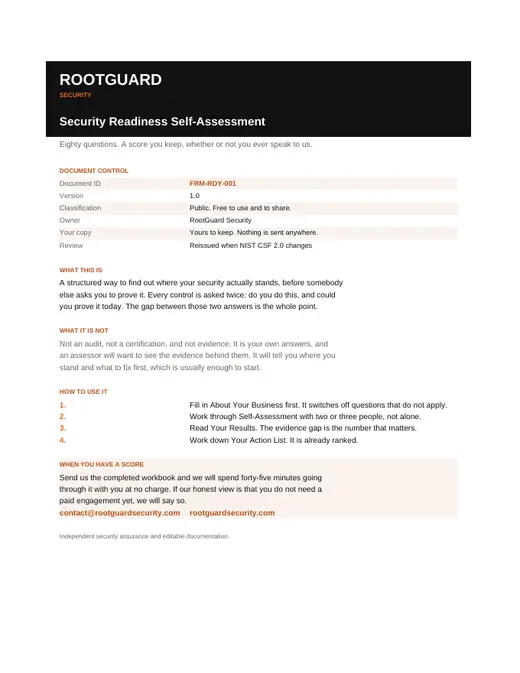
FRM-RDY-001 · XLSX
Eighty questions across all six framework functions. Every control is asked twice: do you do this, and could you prove it today.
DownloadWhat is in itSpreadsheets you maintain rather than read. Each is what we would start from on an engagement, with the scales and the worked examples left in.

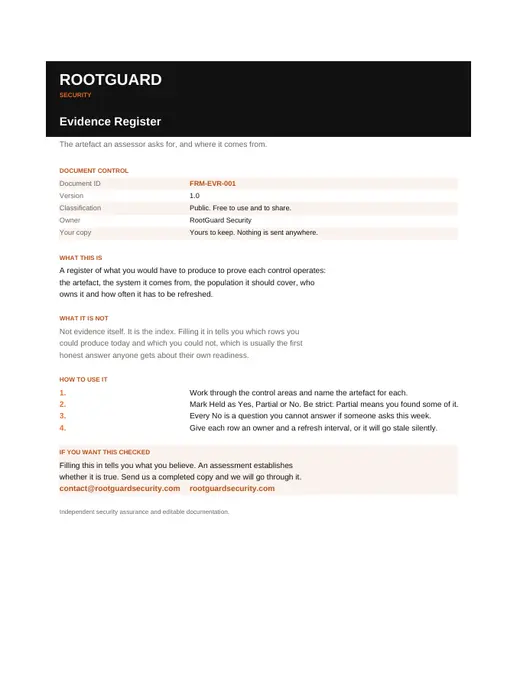
FRM-EVR-001 · XLSX
Evidence items with the artifact, the source system, the population it must cover and how often to refresh it. The document that turns every future audit into a lookup.
Download
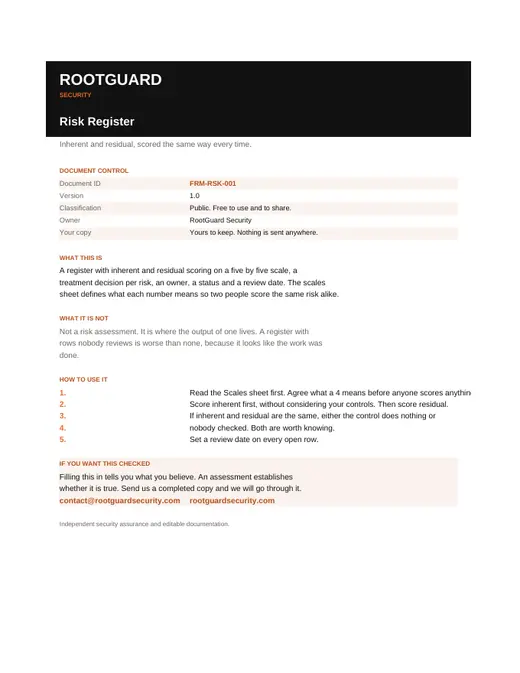
FRM-RSK-001 · XLSX
Auto-scoring matrix, likelihood and impact before and after treatment, adaptable scales and a worked example.
Download
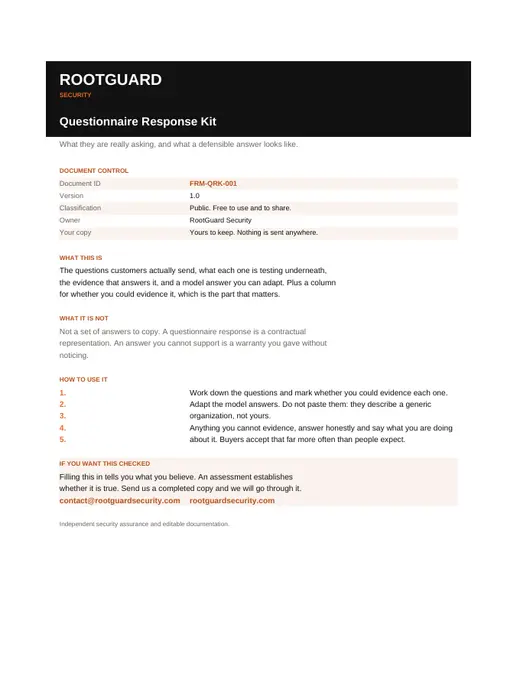
FRM-QRK-001 · XLSX
The fifty questions customers ask most, what each is really testing, the evidence that answers it, and a model answer to adapt. With a gap summary.
Download
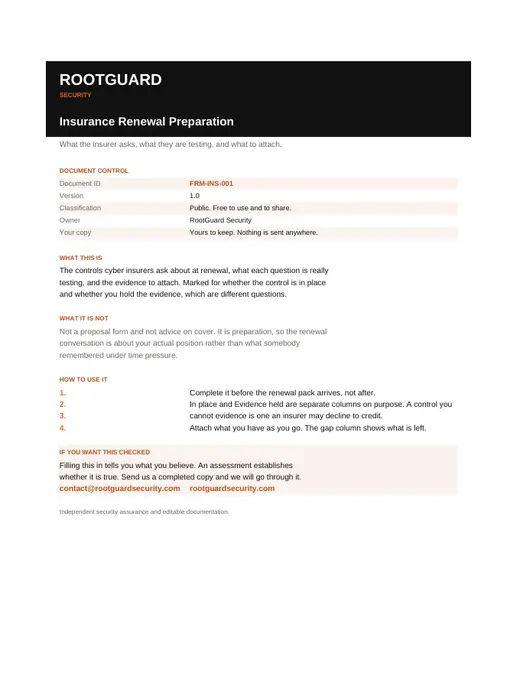
FRM-INS-001 · XLSX
The controls insurers ask about, what each question tests, and the evidence to attach. Work through it a month before renewal.
Download
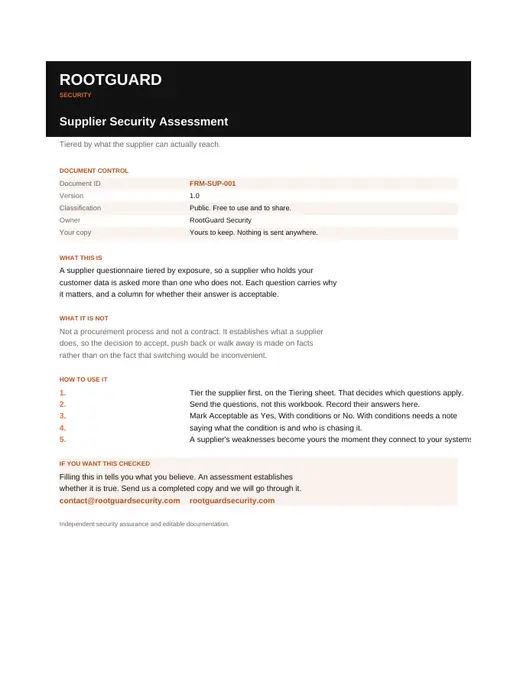
FRM-SUP-001 · XLSX
Questions tiered by supplier risk, so a low-risk supplier answers a handful and a critical one answers all of them.
Download
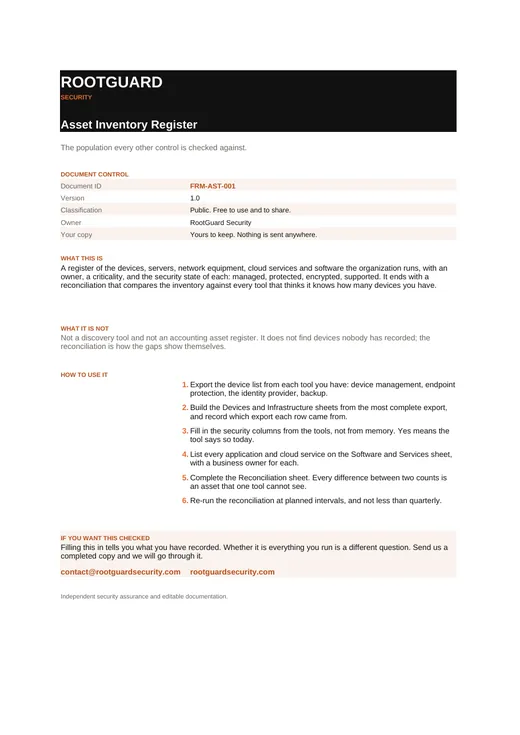
FRM-AST-001 · XLSX
Devices, infrastructure and software, each with an owner, a criticality and its security state, plus a reconciliation that compares the inventory with every tool that counts devices. The denominator every other control is measured against.
Download
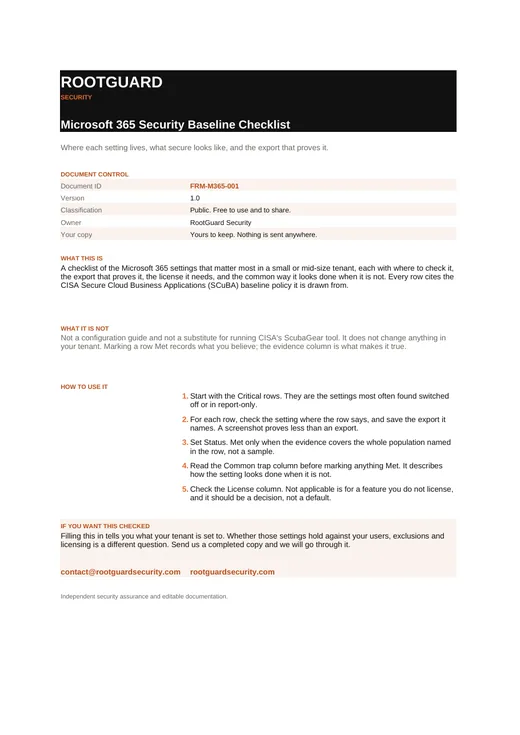
FRM-M365-001 · XLSX
The tenant settings that matter most, each with where to check it, the export that proves it, the license it needs, and the way it looks done when it is not. Every row cites the CISA SCuBA baseline it comes from.
DownloadWritten to be cut down to your organization rather than adopted whole. Every threshold is a number somebody has to agree, and they are marked.

POL-ISMS-001 · DOCX
Covering access, devices, information handling, email fraud, suppliers, backup, reporting and exceptions.
Download
POL-AUP-001 · DOCX
The rules, then guidance for the six situations staff actually face, then why each rule exists. With a one-page quick reference intended to be circulated separately.
Download
POL-BKP-001 · DOCX
Backup types and what each actually protects against, retention set against observed dwell time, restoration order by dependency, four levels of test, cloud and supplier data, plus a restore test record and a recovery runbook.
Download
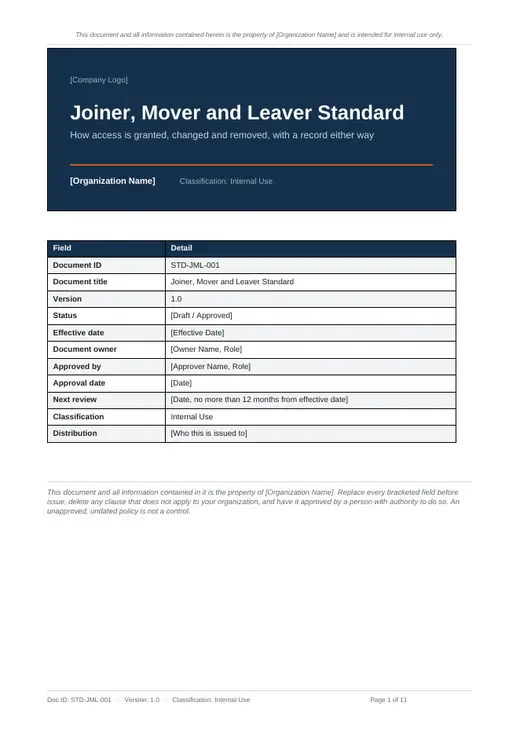
STD-JML-001 · DOCX
Role profiles, the three processes in operational detail, non-routine departures, and the quarterly reconciliation that produces the evidence an assessor asks for first.
Download
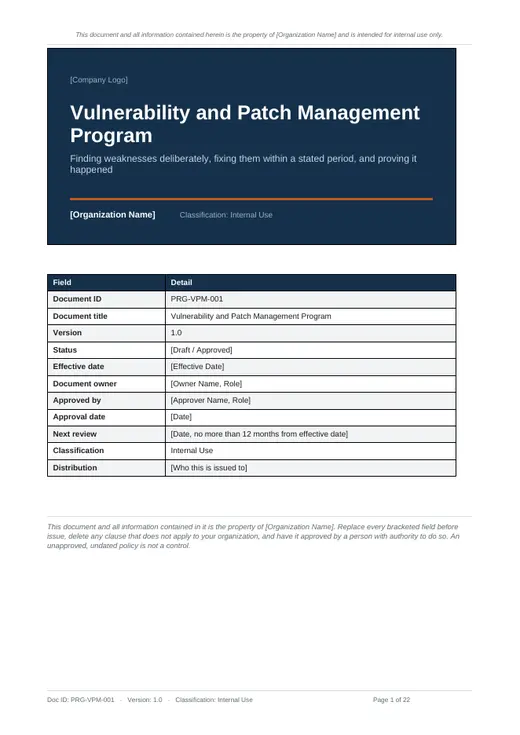
PRG-VPM-001 · DOCX
Zone-based remediation periods stated in hours and days rather than deferred, the three windows of exposure and who controls each, an enforcement ladder with real consequences, and a glossary.
Download
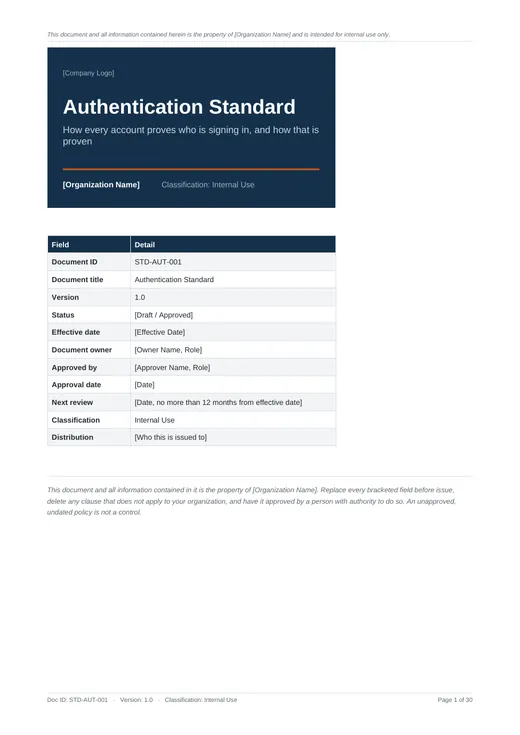
STD-AUT-001 · DOCX
Authenticators ranked by what they resist, privileged and emergency access accounts, legacy protocols, service accounts and help desk resets, with a monthly reconciliation that proves a second factor is enforced on every account rather than registered.
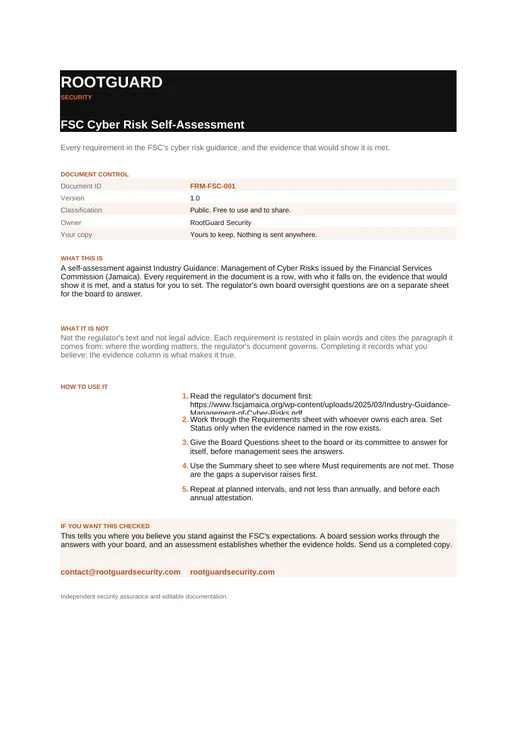
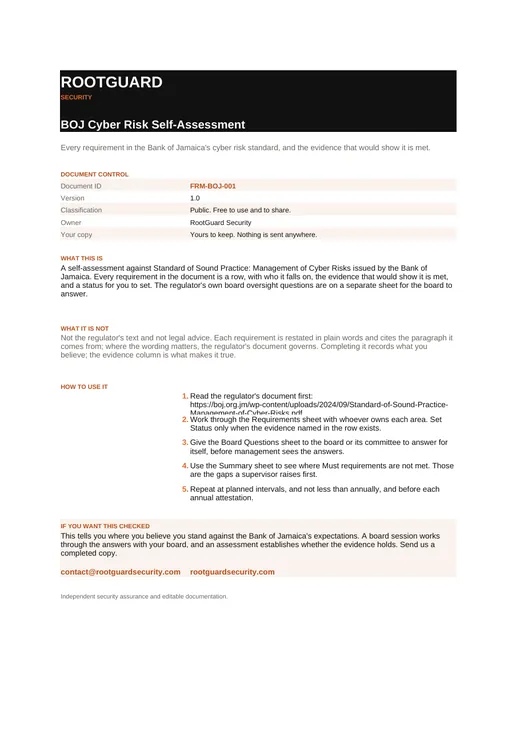
DownloadEvery requirement in a regulator's cyber risk document as a row you can mark against, with the board's own oversight questions on a separate sheet. Each row cites the paragraph it comes from.

FRM-FSC-001 · XLSX
For insurers, pension entities and securities licensees under the Financial Services Commission guidance on managing cyber risk. Who each requirement falls on, the evidence that would show it is met, and the sixty board oversight questions.
Download
FRM-BOJ-001 · XLSX
For deposit-taking institutions under the Bank of Jamaica standard on managing cyber risk. The same structure as the FSC workbook, against the Bank's own text, with a note on the standard's status.
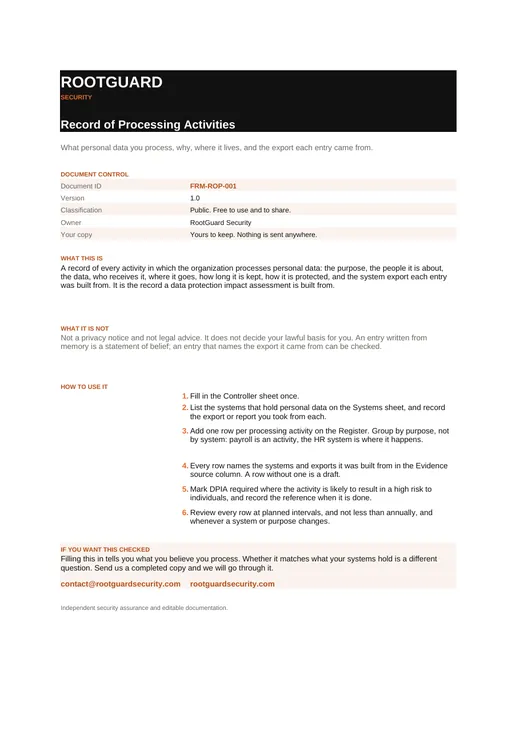
DownloadThe record of what personal data you hold and why, and the assessment that is built from it.

FRM-ROP-001 · XLSX
One row per processing activity with its purpose, lawful basis, data, recipients, transfers, retention and security, and the system export each entry was built from, so the record can be checked rather than believed.
Download
TMP-DPI-001 · DOCX
Screening, the processing description, necessity and proportionality, a defined likelihood and severity scale, inherent and residual risk, and a sign-off in which every residual risk is accepted by somebody named. With a worked example.
DownloadThe documents that matter on the day something happens, and the ones that decide whether anybody above you understands it.
PLN-IR-001 · DOCX
Severity definitions, roles, contact list, the six phases, an incident log and an after-action record.
Download
GDE-TTX-001 · DOCX
Preparation, a facilitator guide including what to listen for, five complete scenarios with timed injects, the closing sequence, reporting and follow-up, plus an invitation, observation sheet and findings log.
Download
GDE-BRD-001 · DOCX
Why security reporting usually fails, the report structure section by section, the measures worth reporting and those worth avoiding, plus a template and a worked example.
Download
PRO-RAN-001 · DOCX
The first hour and what not to do in it, decisions authorized in advance, containment starting with identity, backup protection, notifications, the ransom decision, and recovery in dependency order. Runs under the Incident Response Plan.
Download
PRO-BEC-001 · DOCX
Two first-hour tracks: a redirected payment, where hours decide whether the money comes back, and a taken-over mailbox. With the payment verification controls that stop it happening again.
Download
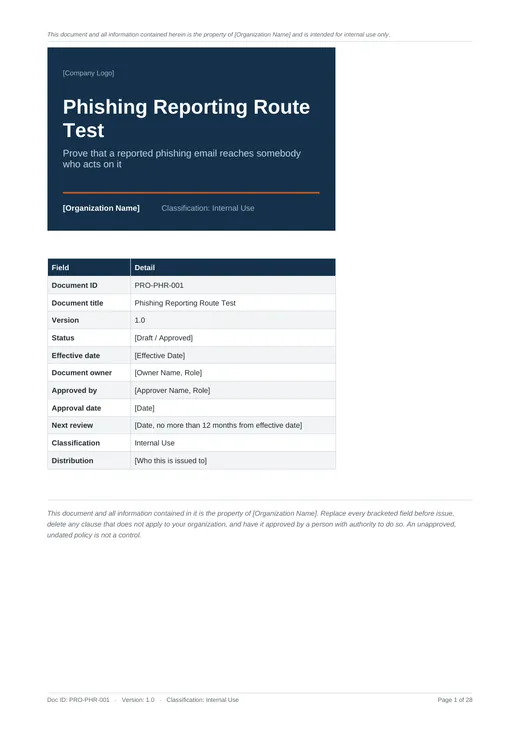
PRO-PHR-001 · DOCX
Whether a reported email reaches somebody who acts on it, and how fast, rather than how many people clicked. Route mapping, a planted report test, a staff simulation and the measures that matter.
DownloadUsually the answer is whichever one your customer, insurer or regulator is asking about, which is a shorter conversation than choosing one on merit.
| Framework | Who Asks for It | What We Provide |
|---|---|---|
| NIST CSF 2.0 | Boards, insurers, general customer due diligence | The spine of the assessment catalogue. 106 controls, one per subcategory. |
| ISO 27001 and 27002 | Overseas customers, tender processes | Mapped documentation packs. A crosswalk from the assessment catalogue is in preparation. |
| SOC 2 Trust Services Criteria | US customers of service providers | Readiness pack and evidence structure. A crosswalk from the assessment catalogue is in preparation. |
| CIS Controls v8 | Technical reviewers, MSP contracts | Covered by the Security Program Pack. Not crosswalked to the assessment catalogue. |
| CMMC and NIST SP 800-171 | US defense supply chain | Level 1 and Level 2 packs. We prepare you; assessment is performed by an authorized body. |
| Data protection regimes | Regulators, customers, parent companies | JDPA, UK GDPR, EU GDPR and equivalents, assessed as obligations rather than as a framework. |
A crosswalk lets one assessment answer more than one question. Ours will cover ISO 27001 and SOC 2 against the NIST CSF spine. It is not built yet, and until it is, this table says so rather than implying otherwise.
Plain-language explainers, written for the person who has to answer a questionnaire rather than for a security team. These are in preparation, and this page will say so until each one exists.
| Guide | What It Answers | Status |
|---|---|---|
| Answering a customer security questionnaire | What the questions are really asking, and how to answer each with evidence rather than a claim | In preparation |
| Policies, standards, procedures and evidence | Why documentation fails audits, and which layer is missing when it does | In preparation |
| Which framework applies to you | NIST CSF, ISO 27001, SOC 2 and CMMC, and how to tell which one your buyer is actually asking about | In preparation |
In the meantime, the notes cover the same ground in shorter form, and the common questions answer what an engagement ends with and what we will not do.
Tell us who is asking and what they asked for. We will say which framework they mean and which of these files gets you furthest, whether or not you ever engage anybody.
Also useful: Readiness assessment · Common questions · Where we are the wrong answer